
What Is Time-of-Use (TOU) Pricing–And Why Arizona Uses It?
March 19, 2026
8 min read
When most homeowners think about solar, they picture panels on the roof quietly producing clean energy and lowering monthly utility bills. While that’s directionally true, the reality is more nuanced—especially in Arizona, where how and when electricity is used matters just as much as how much electricity your solar panels produce.
To truly understand solar savings, it helps to look beyond panels alone and examine how solar and battery systems interact with modern utility rate plans. In this article, we’ll break down how different system configurations perform under a real-world Arizona rate structure and explain why batteries are playing an increasingly important role in controlling energy costs.
To keep things concise, we’ll use one of the most common solar-compatible rate plans in Arizona as our example: APS Time-of-Use (4–7 PM Weekdays) with a Demand Charge. The same principles discussed here apply across other Arizona utilities, including SRP and TEP, although the timing of battery recharge and discharge will differ. .
We’ll also focus on the summer season (May–October)—the time of year when energy use is highest, rates are most impactful, and system design decisions matter most.
Before comparing system types, it’s important to understand what’s on your electric bill—and which portions solar and batteries can actually influence.
While a typical APS bill contains many line items, three charges dominate overall cost and are directly impacted by the application of solar and/or battery technology. Here’s what we can offset directly:
On APS’s Time-of-Use plan, energy prices rise sharply between 4–7 PM on weekdays. This on-peak window is also when the demand charge is measured, creating a narrow but costly three-hour period that can account for a disproportionate share of a home’s monthly electric bill.
SRP rate plans follow a similar structure, with higher on-peak kWh rates and demand fees come together during on-peak time periods to sharply increase a monthly bill. Of course, kWh and demand pricing will differ in SRP, as well as on-peak time periods, but the concept and approach remains the same.
Targeting on-peak hours is where solar and battery technology—when applied correctly—deliver the greatest value. Let’s take a closer look at how three different system configurations perform under this billing structure.
Here’s how APS electricity rates change throughout the day under the Time-of-Use with Demand plan. This example reflects the summer season (May–October), when rates and energy use are at their highest.
.png?width=600&height=400&name=aps%20tou%20graph%201%20(1).png)
Let’s start with the most familiar approach: solar panels only.
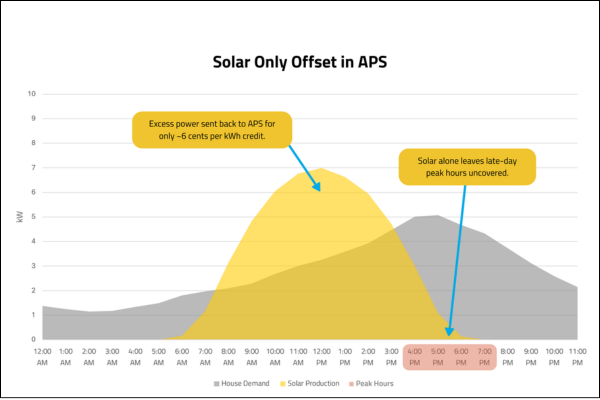
A typical Arizona home’s energy use follows a fairly predictable daily pattern. Consumption rises in the morning, levels out during the day, and then spikes again in the late afternoon and evening as people return home and air conditioning, cooking, and appliances ramp up.
Solar production follows a slightly different curve. Panels generate energy from dawn to dusk, with peak output occurring midday—when sunlight is strongest – and ramping down as the sun dips lower in the horizon later in the day.
Solar panels are highly effective at offsetting daytime energy use, particularly during off-peak hours when APS energy rates are relatively low. In many cases, a solar system will generate more electricity than the home is using during the middle of the day. That excess energy can be exported to the grid, where utilities—including APS—provide a bill credit that can help offset electricity purchased later, when solar production is lower.
However, these export credits have declined significantly in recent years. Today, APS credits excess solar at roughly $0.06 per kWh, which is far lower than the cost of on-peak electricity under the Time-of-Use with Demand plan—where peak energy prices reach 14.22¢ per kWh. This growing gap makes it increasingly difficult for solar credits alone to fully offset expensive on-peak energy use.
The challenge appears as the day moves toward evening.
Between 4–7 PM, energy prices rise dramatically—often exceeding $0.14 per kWh—just as solar production begins to taper off. At that point, homeowners are forced to purchase electricity from the grid at peak rates.
A solar-only strategy relies on daytime export credits to offset those evening purchases. However, the math becomes difficult when you’re trading 6-cent credits for 14-cent energy. Even with a well-sized solar system, credits alone often struggle to fully offset peak-hour consumption.
Solar panels also have limited ability to reduce demand charges.
Demand charges are triggered by short-duration spikes in electricity usage—often caused by air conditioners, ovens, or multiple appliances switching on simultaneously – usually after work when people return home. Solar panels produce energy at a relatively steady rate and cannot suddenly increase their output to counter a sudden energy spike.
As a result, solar-only systems typically:
Solar is a powerful tool—but on modern rate plans, it’s often only part of the solution. Here's how the solar only energy profile looks relative to APS pricing throughout the day.
Next, let’s look at battery-only systems, sometimes referred to as stand-alone storage. Unlike solar panels, batteries don’t generate energy—they store it and discharge it when it provides the greatest benefit.
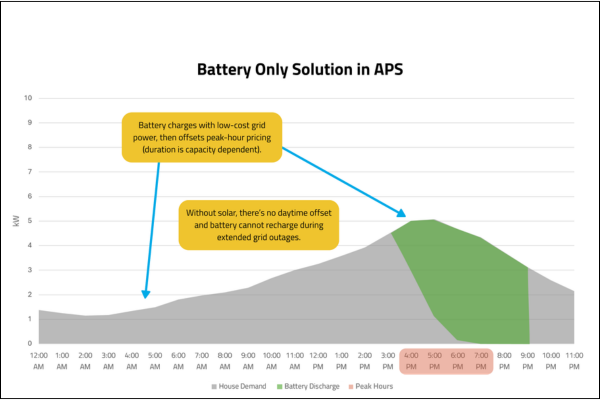
That benefit can take several forms: supplying power during a grid outage, discharging low-cost stored energy during the most expensive hours of the day to reduce utility charges, or a combination of both. In each case, the battery’s value comes from when the energy is used—not where it came from.
Under this approach, the battery:
During the 4–7 PM window, the battery supplies power to the home, effectively reducing or eliminating grid usage during the most expensive hours of the day. In short, it uses stored off-peak energy to effectively take the home off grid during the on-peak windows of time – avoiding the most expensive kWh and demand fees entirely.
Even though a battery does not offset daytime usage, it attacks the most expensive portion of the bill directly:
Because these charges represent a large share of total costs, the savings from a battery-only system can be immediate and measurable, even without solar panels.
Another advantage is lower upfront cost. A stand-alone battery system typically costs less than a combined solar-plus-battery installation, making it a more accessible entry point for some homeowners.
Solar panels can always be added later to further expand savings.
Many stand-alone battery systems can also provide limited blackout protection, depending on how big they are and how they’re configured. However, without solar panels, backup power is constrained by the battery’s stored energy. Once the battery is depleted during an outage, it cannot recharge until grid power is restored. This makes battery-only systems best suited for short outages and bill management, rather than long-duration energy independence.
The most comprehensive solution is the hybrid approach, which combines solar panels with battery storage to address both off-peak and on-peak energy use, while also ensuring the home remains powered and able to self-recharge during extended grid outages.
This configuration targets all major cost drivers on modern utility bills and delivers the highest level of resilience, flexibility, and energy security.
During the day:
As evening approaches:
This strategy effectively takes the home off grid during the most expensive hours of the day.
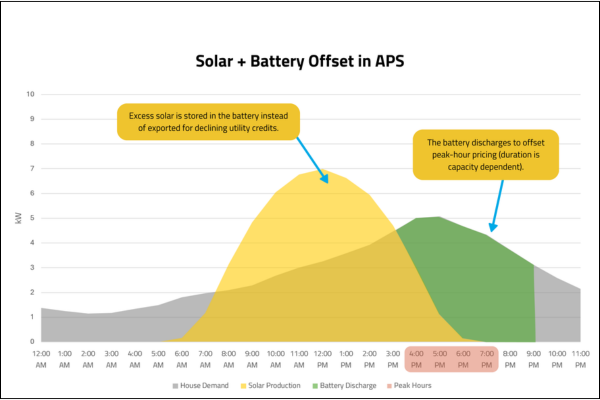
A properly designed solar-plus-battery system:
Because stored solar energy is used onsite instead of sold back cheaply, homeowners capture far more value from every kilowatt-hour their system produces.
In addition to bill savings, hybrid systems can be configured to provide true energy resilience in the event of a grid outage.
During a blackout:
As long as sunlight is available and energy use is managed, the system can operate indefinitely—making this approach ideal for extended outages and critical loads.
Hybrid systems are:
However, Hybrid Systems also deliver:
For many Arizona homeowners, this approach offers the best overall balance of economics, performance, and peace of mind. It’s also the most effective way to hedge against future rate increases—by generating and storing the majority of your own energy, you become far less reliant on the grid than with either of the other two scenarios.
There is no single “best” system for every home. The right solution depends on your priorities, budget, and how your utility charges for electricity:
What matters most is system design—matching the technology to your utility rate plan, usage patterns, and long-term goals. While the examples above reference APS for clarity, the same principles apply to most major Arizona utilities offering a time-of-use rate plan, including SRP and TEP. The core strategy remains the same: charge when energy is least expensive and discharge when rates and demand charges are highest. Only the specific charge and discharge windows change to align with each utility’s on-peak hours.
As Arizona utilities continue shifting toward time-of-use and demand-based pricing, understanding these interactions is becoming increasingly important. Solar panels still play a critical role, but batteries are often the key to unlocking their full value.
Solar is no longer just about producing energy—it’s about using energy smarter. By aligning solar and battery systems with how utilities charge for electricity, homeowners can take control of their bills, reduce exposure to rising rates, and build a more resilient energy future.